2025/09/16
András Göde
9 perc
minute reading
When we talk about acoustics, most of us think of concert halls or theaters. But the sound world defines every space. Sounds constantly surround us – unlike our eyes, we can't close our ears.
We perceive sounds in a spherical way: our ears can not only pinpoint the sound source from all directions but also judge distance. Our brain filters like an error-correcting system: separating distracting noise from important information. However, this requires effort. In a space with poor acoustics, we get tired faster, our concentration decreases, and we become more restless.
Thus, acoustics affect not only understanding but also mood. We store heard sounds, compare them with our past experiences, and associate them with specific places. Silence is linked with libraries, noise with a bustling place, and echo with a church. Any deviation would be disturbing: staying focused in a noisy library would be difficult, and a silent school hallway would feel strange. The echoey spaces of churches not only visually but acoustically also tune us into reverence.
Pallasmaa, the Finnish architect, and theorist, says in his book The Eyes of the Skin:
“Architectural space is a lived space, not a physical volume, and lived space always transcends geometry and measurability.”
Sound is therefore a part of lived space.
Gernot Böhme, the German philosopher who was one of the pioneering researchers of the concept of atmosphere, put it this way in an interview:
“The atmosphere is nothing but a tuned space.”
The metaphor is apt: the atmosphere of a space reaches us like music. It recalls memories in us, associates emotions, and creates a mood.
But not only spaces, materials have a sound too. We learn and store this in our memories just like sights. Swiss architect Peter Zumthor writes in his book Atmospheres that our steps sound completely different on glued parquet compared to a floor on joists. We learn the sound-absorbing or reflecting properties of materials, as well as the distinct sound of a tapped surface. Sight and sound blend together, jointly shaping the perception of space.
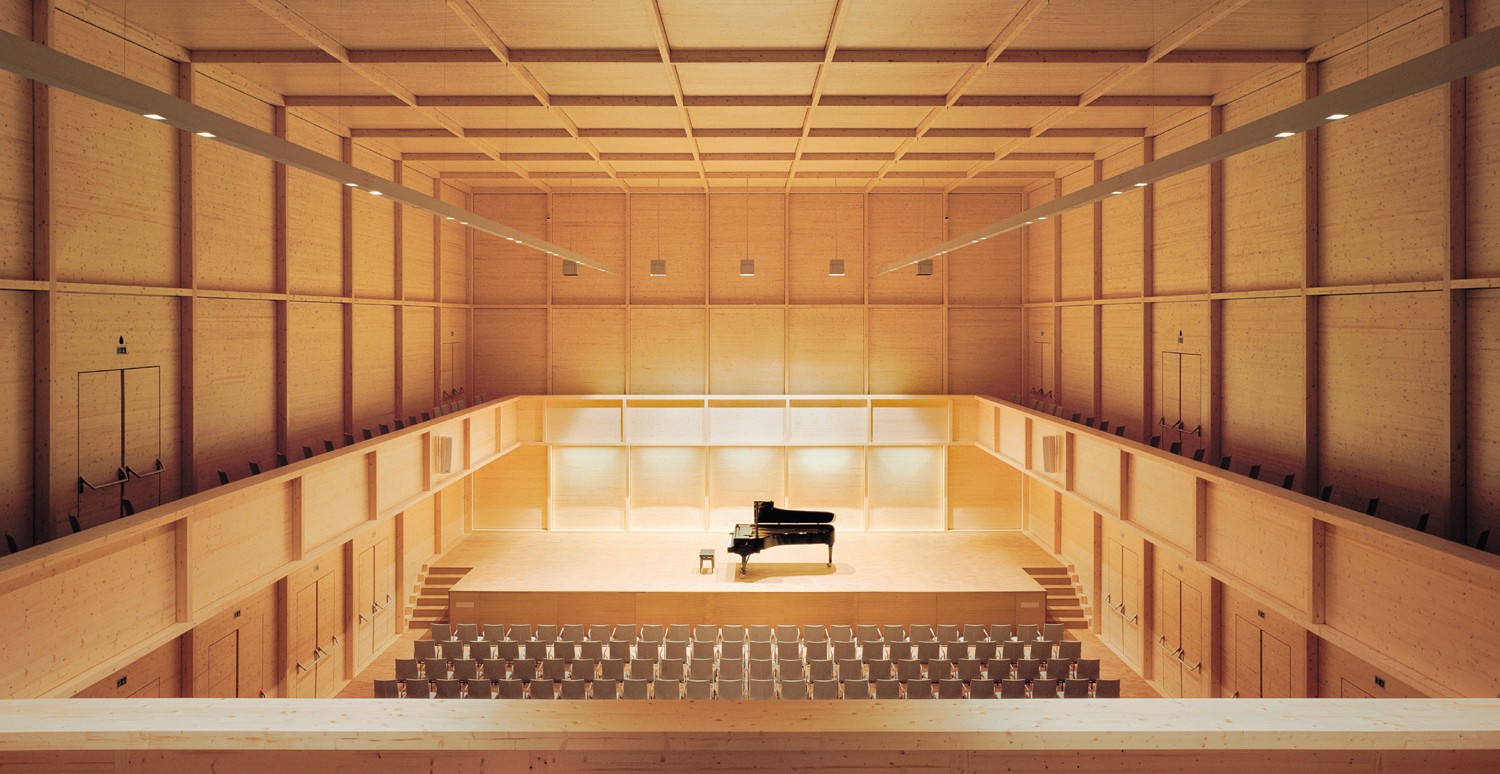
It's no coincidence that wood is the preferred material in concert halls: besides its acoustic properties, we psychologically associate it with music, as the most common material for instruments. The resonance of wood, the cold tap of stone, the dull calm of textiles – all contribute to how we experience the atmosphere of a place.
A good space speaks to the ears as much as the eyes. And when sight and sound converge, what we call atmosphere is born – a complex experience that cannot be simply measured, yet fundamentally determines how we feel in a given place.
But not only spaces, materials have their own sound as well. We learn and store these in our memories just like visual impressions. Swiss architect Peter Zumthor writes in his book Atmospheres that our footsteps sound completely different on glued parquet compared to a floor laid on joists. We learn the sound-absorbing or reflecting qualities of materials, just like the unique sound of a surface when tapped. Visuals and sounds merge together, shaping our perception of space.
It's no coincidence that wood is the favorite material in concert halls; besides its acoustic properties, we also associate it mentally with music, as it's the most common material for instruments. The resonance of wood, the cold clink of stone, the muted tranquility of textiles—all contribute to how we experience the atmosphere of a place.
A good space speaks not only to the eyes but also to the ears. And when visuals and sounds come together, that's when something magical happens that we call atmosphere—a complex experience that can't be simply described with measurements but fundamentally dictates how we feel in a given place.